"Most people get interested in stocks when everyone else is. The time to get interested is when no one else is. You can't buy what is popular and do well." - Warren Buffett
Saturday, 27 June 2020

Cicero’s 146 (43 B.C) of the Roman empire wrote a philosophy that is still valid?

Friday, 26 June 2020
Quote for the day
"If we become increasingly humble about how little we know, we may be more eager to search." - John Templeton
Investing vs. Trading: What’s the Difference?
Why Trading and Investing are so Fundamentally Different
There is a popular misconception that trading and investing could be used interchangeably with one another. But as professional traders and investors can attest to, they are both radically different. It’s easy to mix the terms when both activities share the same objective: make money in the stock market.
But their opposite approaches to achieve that objective is what makes them so distinct. To put it in its simplest form, traders trade tickers and investors invest in companies. Let’s break this phrase down in more detail by focusing on three main concepts associated with each activity.
1. Primary Philosophy: Although investors could sometimes bleed into what a trader does and traders could bleed into what an investor does, the main philosophy to take away is that one is purely based off fundamentals and the other is based on technicals.
Investors primarily look at the stock market from a fundamental standpoint. When choosing a stock, investors are entirely invested in what a company does and will continue to do. They care more about the bottom line. They look at a company’s financial reports which consist of balance sheets, income statements, cash flow statements, and various other required documents that the company has to disclose to their shareholders.
These reports give shareholders a look at a company’s debt relative to their overall cash flow, their market share compared to their competitors, their growth and projections, and most importantly, how much profit they’re bringing in. These are all things investors care about. They’re thoroughly listening to a company’s conference call during earnings season, the amount of dividend they’ll pay out for the quarter, and any other relevant information an investor would need to decide if they’re willing to buy the company’s stock.
Traders primarily look at the stock market from a technical standpoint. They use various tools that most likely an investor would not. One of those tools is a stock scanner. This is a vital tool that helps traders find their stocks at any given moment by filtering specific settings to their liking. It’ll allow them to choose any stock whether it’s gapping up or down, is a small or large cap, has high or low volume, or has a high or low float. This is all technical jargon you probably wouldn’t find an investor searching for. The point is that traders are looking for these big swings in price fluctuations to make a potential profit and these filters within the stock scanner can help them find that.
While investors are viewing a company’s financial reports, traders are vigorously viewing a company’s stock chart. And within that chart, traders have many study indicators they use at their disposal to figure out entries and exits. They study indicators that could be tools like moving averages to assess whether a stock’s trend is bullish or bearish or a relative strength index (RSI) to determine whether that stock is oversold or overbought.
But before traders even trade a stock, they are watching for certain patterns within that chart. Every trader has a strategy and they’re looking to see if they can find a pattern that falls within their strategy. Traders then look for validated levels of support and resistance. They evaluate a myriad of other factors like the spread between the bid and the ask on the level 2, the kind of transaction going through on the time & sales, and the type of candlestick they’re about to buy into. All of these tools are specifically important for a day trader. More on that later.
2. Duration: As any sound investor can tell you, never try to time the market. Investors are not interested in paying attention to daily price movements or even weekly price movements for that matter like traders are. They’re not paying attention to market volatility as much as a trader. Their outlook is substantially longer-term than a trader’s. And that outlook could be at least 5 years and certainly greater than a year. Timing the market is a fool’s errand for an investor.
For a trader, however, timing the market is everything. Swing traders are looking to buy low and sell high or buy high and sell low if they’re shorting multiple times by taking advantage of these price fluctuations where as an investor would typically not care and just sit back. A trend trader tries to buy high and sell higher or short sell low and buy back lower. In other words, a trader will buy a stock short to mid-term where as an investor will buy a stock for the long-term.
It’s also important to distinguish the kind of trader a person is. A day trader will buy and sell a stock on that same day within hours, minutes, or even seconds. And a swing trader will hold a stock for at least a day.
3. Skill Level: Spending more time in the market naturally will expose you to more level of risk. A trader’s time in the market can be significantly longer than an investor’s in terms of buying and selling and therefore require a bit more skill level to be successful in making money.
A trader has to cut losses more quickly where as an investor can wait for the company to bounce back if they hit a roadblock as long as their fundamentals remain intact.
Each of these activities require a different kind of mindset as well. Investors need to have some level of belief or intuition in a company that they’re buying. A trader’s approach is a little less emotional. In fact, their decisions should all be based on logic when analyzing the technical setup of a stock.
Final Thoughts
Regardless of how you approach the stock market, extensive research is undoubtedly required. A trader must check off a multitude of technical conditions to see if a stock is worth trading. And an investor has to study the ins and outs of a company to see if their financial philosophy and overall product or service is sustainable for long-term growth.
There is a popular misconception that trading and investing could be used interchangeably with one another. But as professional traders and investors can attest to, they are both radically different. It’s easy to mix the terms when both activities share the same objective: make money in the stock market.
But their opposite approaches to achieve that objective is what makes them so distinct. To put it in its simplest form, traders trade tickers and investors invest in companies. Let’s break this phrase down in more detail by focusing on three main concepts associated with each activity.
1. Primary Philosophy: Although investors could sometimes bleed into what a trader does and traders could bleed into what an investor does, the main philosophy to take away is that one is purely based off fundamentals and the other is based on technicals.
Investors primarily look at the stock market from a fundamental standpoint. When choosing a stock, investors are entirely invested in what a company does and will continue to do. They care more about the bottom line. They look at a company’s financial reports which consist of balance sheets, income statements, cash flow statements, and various other required documents that the company has to disclose to their shareholders.
These reports give shareholders a look at a company’s debt relative to their overall cash flow, their market share compared to their competitors, their growth and projections, and most importantly, how much profit they’re bringing in. These are all things investors care about. They’re thoroughly listening to a company’s conference call during earnings season, the amount of dividend they’ll pay out for the quarter, and any other relevant information an investor would need to decide if they’re willing to buy the company’s stock.
Traders primarily look at the stock market from a technical standpoint. They use various tools that most likely an investor would not. One of those tools is a stock scanner. This is a vital tool that helps traders find their stocks at any given moment by filtering specific settings to their liking. It’ll allow them to choose any stock whether it’s gapping up or down, is a small or large cap, has high or low volume, or has a high or low float. This is all technical jargon you probably wouldn’t find an investor searching for. The point is that traders are looking for these big swings in price fluctuations to make a potential profit and these filters within the stock scanner can help them find that.
While investors are viewing a company’s financial reports, traders are vigorously viewing a company’s stock chart. And within that chart, traders have many study indicators they use at their disposal to figure out entries and exits. They study indicators that could be tools like moving averages to assess whether a stock’s trend is bullish or bearish or a relative strength index (RSI) to determine whether that stock is oversold or overbought.
But before traders even trade a stock, they are watching for certain patterns within that chart. Every trader has a strategy and they’re looking to see if they can find a pattern that falls within their strategy. Traders then look for validated levels of support and resistance. They evaluate a myriad of other factors like the spread between the bid and the ask on the level 2, the kind of transaction going through on the time & sales, and the type of candlestick they’re about to buy into. All of these tools are specifically important for a day trader. More on that later.
2. Duration: As any sound investor can tell you, never try to time the market. Investors are not interested in paying attention to daily price movements or even weekly price movements for that matter like traders are. They’re not paying attention to market volatility as much as a trader. Their outlook is substantially longer-term than a trader’s. And that outlook could be at least 5 years and certainly greater than a year. Timing the market is a fool’s errand for an investor.
For a trader, however, timing the market is everything. Swing traders are looking to buy low and sell high or buy high and sell low if they’re shorting multiple times by taking advantage of these price fluctuations where as an investor would typically not care and just sit back. A trend trader tries to buy high and sell higher or short sell low and buy back lower. In other words, a trader will buy a stock short to mid-term where as an investor will buy a stock for the long-term.
It’s also important to distinguish the kind of trader a person is. A day trader will buy and sell a stock on that same day within hours, minutes, or even seconds. And a swing trader will hold a stock for at least a day.
3. Skill Level: Spending more time in the market naturally will expose you to more level of risk. A trader’s time in the market can be significantly longer than an investor’s in terms of buying and selling and therefore require a bit more skill level to be successful in making money.
A trader has to cut losses more quickly where as an investor can wait for the company to bounce back if they hit a roadblock as long as their fundamentals remain intact.
Each of these activities require a different kind of mindset as well. Investors need to have some level of belief or intuition in a company that they’re buying. A trader’s approach is a little less emotional. In fact, their decisions should all be based on logic when analyzing the technical setup of a stock.
Final Thoughts
Regardless of how you approach the stock market, extensive research is undoubtedly required. A trader must check off a multitude of technical conditions to see if a stock is worth trading. And an investor has to study the ins and outs of a company to see if their financial philosophy and overall product or service is sustainable for long-term growth.
Source: www.newtraderu.com/
Thursday, 25 June 2020
Quote for the day
"The best kept secret in the investing world: Almost nothing turns out as expected." - Harry Browne
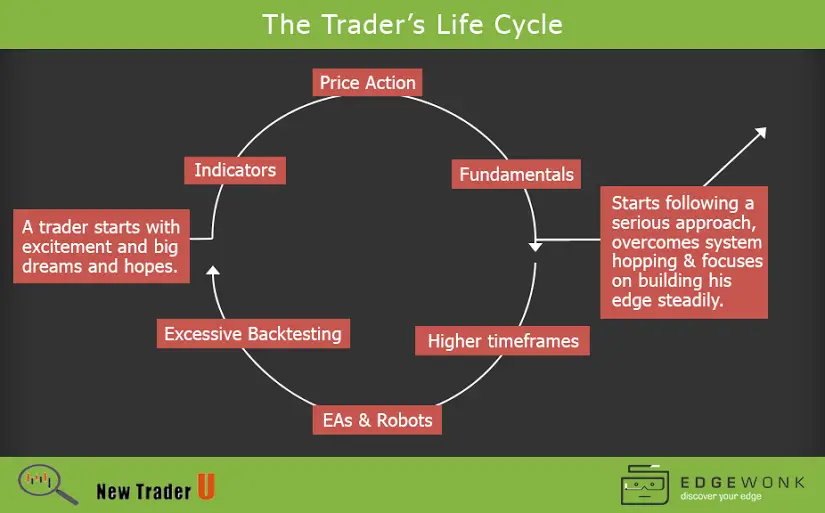
The Life Cycle of the Typical Trader
The exciting start
Do you remember how you got started in trading? Everything seemed possible, and you were ecstatic about the possibilities that trading offered, but what happened afterwards? This article will help you understand the different phases almost all traders will go through, why they are stuck in the same routine, and where they go wrong. It will help you avoid making the same mistakes, and save you some time along the way.
The indicator phase
When traders start out, most will start by using a variety of different indicators. After all, indicators look very sophisticated, they provide a very clear signal, and they transform what you see on your charts into easy to digest information.
New traders don’t really know what they are doing, and don’t understand what the indicators tell them; they just look for trade signals without having ‘to do too much work’.
The price action phase – less is more
When traders move on, they adopt the ‘get rid of the mess’ approach, and use phrases like ‘keep it simple’ or ‘only trade what you see’. Price action trading, and looking at blank price charts is where they will go, because price is ‘the purest form of information’, or at least this is what people tell you.
After leaving indicators behind, traders report that they feel free, and can finally see beyond the indicators. They understand what is really moving the markets. Needless to say, it does not really matter whether you are using price action or indicators – but this insight will come much later, if ever, in a trader’s life cycle.
Higher timeframes – less noise and more time to enjoy your freedom
Lower time frames are so noisy, and even though your trading strategy might be profitable, it is disproportionately harder on the lower time frames, isn’t it? A typical thought in this phase goes something like this:
‘When I finally trade profitably on the higher time frames, which is easier, I have more time to enjoy life; the reason I came to trading in the first place.’
Every time frame is unique, and the characteristics and skill-set you need to have for each time frame differ significantly. Traders who switch to higher time frames have to deal with completely different emotions. If you tend to make impulsive trading decisions and have difficulty executing trades with patience, trading time frames where you have to wait weeks for a signal to be validated, or stay in trades for days and weeks, and withstand drawdowns calmly, will often result in a whole new set of problems.
Fundamentals – understanding the context
Next, traders start reading news articles and learning about macroeconomic figures. They try to understand the overall market sentiment, since this is the actual factor which is moving the markets.
The fundamental phase is usually short, since traders notice relatively quickly how difficult it is to understand fundamental data. It isn’t as easy as trading absolute numbers of news releases.
Automation – removing the personal mistakes
EAs, trading robots and automated trading strategies seem like the perfect way out. They remove the personal factors that are responsible for trader failure. You get rid of emotions, avoid impulsive trading mistakes, and stop unnecessarily messing up your trades, by fully automating your trading approach.
Traders usually underestimate the factor that markets are never the same. The fact that financial markets are constantly changing, going from trending to ranging mode, having different phases of volatility and even the way markets respond to price behavior and other trading tools changes, is causing major problems for automated trading strategies. They require constant monitoring and adjusting the algorithms.
Back-testing – Finding what has worked before
After some frustrations, and without really seeing any improvements, traders usually start backtesting different trading ideas excessively. Before they are ready to invest more money, they want to make sure that their approach has worked before and, therefore, has a higher chance of working going forward; at least theoretically.
Back-testing, similar to automated trading, underestimates the changing nature of financial markets. Furthermore, backtesting avoids a variety of common issues that traders have to deal with during live trading which include: executing patience, feeling the pressure of having real money on the line and seeing the whole context of financial markets. Needless to say, backtesting results (almost) never translates into actual trading success.
Completing the cycle
Giving up
Most traders will go through this cycle once and then have enough and give up. Studies of retail trading data confirm that 40% of all traders quit after one month and a staggering 80% of all traders quit after 2 years.
The reason is that their dreams and hopes about fast and easy money have been destroyed, and they come to the conclusion (without losing lots of money, hopefully), that trading is not the easy task they were looking for.
Repeating the cycle
The ones who do not quit and keep on chasing their dream will repeat the cycle over and over again. However, traders will alternate between different phases of the cycle, leaving out some completely, and stick to others longer.
Adopting a professional and serious approach
At one point, some of the traders that are still left will come to the conclusion that they need to escape this cycle and try a different approach. Trading without the belief in the Holy Grail, and trading detached from the get rich quick mindset, often enables traders to tackle the whole situation in a completely different way.
Once traders stop system hopping, start implementing a trading plan and a trading journal and pay attention to detail, they have a chance of making it in this business. By understanding that the markets are not your greatest enemy, but that you yourself and your wrong beliefs are the factors that are causing you to make the wrong decisions, you can finally start focusing on the important aspects.
Our tips for a professional trading approach:
* Stick to one system only and stop system-hopping
Do you remember how you got started in trading? Everything seemed possible, and you were ecstatic about the possibilities that trading offered, but what happened afterwards? This article will help you understand the different phases almost all traders will go through, why they are stuck in the same routine, and where they go wrong. It will help you avoid making the same mistakes, and save you some time along the way.
The indicator phase
When traders start out, most will start by using a variety of different indicators. After all, indicators look very sophisticated, they provide a very clear signal, and they transform what you see on your charts into easy to digest information.
New traders don’t really know what they are doing, and don’t understand what the indicators tell them; they just look for trade signals without having ‘to do too much work’.
The price action phase – less is more
When traders move on, they adopt the ‘get rid of the mess’ approach, and use phrases like ‘keep it simple’ or ‘only trade what you see’. Price action trading, and looking at blank price charts is where they will go, because price is ‘the purest form of information’, or at least this is what people tell you.
After leaving indicators behind, traders report that they feel free, and can finally see beyond the indicators. They understand what is really moving the markets. Needless to say, it does not really matter whether you are using price action or indicators – but this insight will come much later, if ever, in a trader’s life cycle.
Higher timeframes – less noise and more time to enjoy your freedom
Lower time frames are so noisy, and even though your trading strategy might be profitable, it is disproportionately harder on the lower time frames, isn’t it? A typical thought in this phase goes something like this:
‘When I finally trade profitably on the higher time frames, which is easier, I have more time to enjoy life; the reason I came to trading in the first place.’
Every time frame is unique, and the characteristics and skill-set you need to have for each time frame differ significantly. Traders who switch to higher time frames have to deal with completely different emotions. If you tend to make impulsive trading decisions and have difficulty executing trades with patience, trading time frames where you have to wait weeks for a signal to be validated, or stay in trades for days and weeks, and withstand drawdowns calmly, will often result in a whole new set of problems.
Fundamentals – understanding the context
Next, traders start reading news articles and learning about macroeconomic figures. They try to understand the overall market sentiment, since this is the actual factor which is moving the markets.
The fundamental phase is usually short, since traders notice relatively quickly how difficult it is to understand fundamental data. It isn’t as easy as trading absolute numbers of news releases.
Automation – removing the personal mistakes
EAs, trading robots and automated trading strategies seem like the perfect way out. They remove the personal factors that are responsible for trader failure. You get rid of emotions, avoid impulsive trading mistakes, and stop unnecessarily messing up your trades, by fully automating your trading approach.
Traders usually underestimate the factor that markets are never the same. The fact that financial markets are constantly changing, going from trending to ranging mode, having different phases of volatility and even the way markets respond to price behavior and other trading tools changes, is causing major problems for automated trading strategies. They require constant monitoring and adjusting the algorithms.
Back-testing – Finding what has worked before
After some frustrations, and without really seeing any improvements, traders usually start backtesting different trading ideas excessively. Before they are ready to invest more money, they want to make sure that their approach has worked before and, therefore, has a higher chance of working going forward; at least theoretically.
Back-testing, similar to automated trading, underestimates the changing nature of financial markets. Furthermore, backtesting avoids a variety of common issues that traders have to deal with during live trading which include: executing patience, feeling the pressure of having real money on the line and seeing the whole context of financial markets. Needless to say, backtesting results (almost) never translates into actual trading success.
Completing the cycle
Giving up
Most traders will go through this cycle once and then have enough and give up. Studies of retail trading data confirm that 40% of all traders quit after one month and a staggering 80% of all traders quit after 2 years.
The reason is that their dreams and hopes about fast and easy money have been destroyed, and they come to the conclusion (without losing lots of money, hopefully), that trading is not the easy task they were looking for.
Repeating the cycle
The ones who do not quit and keep on chasing their dream will repeat the cycle over and over again. However, traders will alternate between different phases of the cycle, leaving out some completely, and stick to others longer.
Adopting a professional and serious approach
At one point, some of the traders that are still left will come to the conclusion that they need to escape this cycle and try a different approach. Trading without the belief in the Holy Grail, and trading detached from the get rich quick mindset, often enables traders to tackle the whole situation in a completely different way.
Once traders stop system hopping, start implementing a trading plan and a trading journal and pay attention to detail, they have a chance of making it in this business. By understanding that the markets are not your greatest enemy, but that you yourself and your wrong beliefs are the factors that are causing you to make the wrong decisions, you can finally start focusing on the important aspects.
Our tips for a professional trading approach:
* Stick to one system only and stop system-hopping
* Stop focusing on entries only as the Holy Grail
* Adhere to risk and money management principles
* Do not personalize losses
* Start tracking your trades in a trading journal to find negative patterns and find out what is causing you to lose money
* Start using a trading plan to avoid impulsive trading decisions

Source:www.newtraderu.com
Source:www.newtraderu.com
Wednesday, 24 June 2020
Quote for the day
"A person with a flexible schedule and average resources will be happier than a rich person who has everything except a flexible schedule. Step one in your search for happiness is to continually work toward having control of your schedule." - Scott Adams
Subscribe to:
Posts (Atom)